
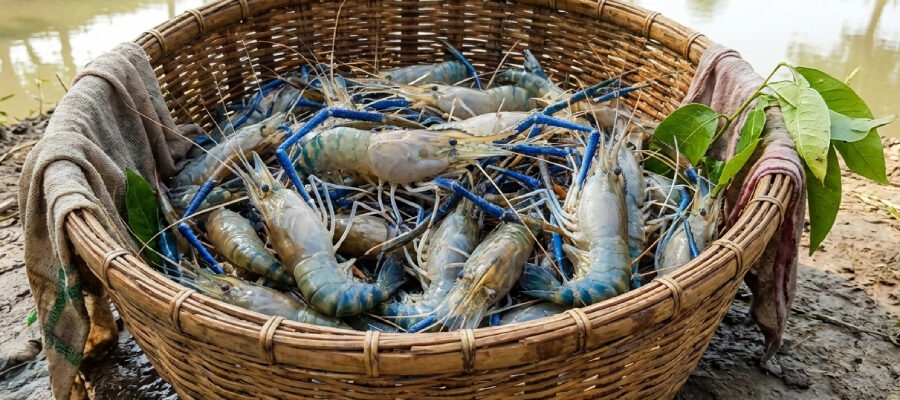
Golda (Macrobrachium rosenbergii), also known as the Giant River Prawn, is the most popular freshwater/brackish water prawn in Bangladesh. It thrives in slightly brackish water with salinity levels below 5 ppt; therefore, Golda farming is particularly profitable in the salt-prone regions of the southwest.
1. Salinity and Water Environment Management
Golda prawns can be farmed in both fresh and slightly brackish water; salinity should generally be kept below 5 ppt (5 grams of salt per thousand). If the salinity is high, acclimating the prawns gradually from low to high salinity reduces the mortality rate. Maintaining stable salinity by adding salt daily improves the production and growth of eggs and larvae; in modern practices, 250 grams of salt per decimal is applied every month.
2. Pond/Gher Selection and Preparation
It is ideal for the pond bottom to have soft mud, but an accumulation of tree leaves or organic waste is unsuitable for prawns; the decomposition of these materials depletes oxygen, leading to prawn deaths. Predatory fish will eat both prawn larvae and adults; therefore, it is essential to completely eradicate them or clean the pond using the salt-bleaching method before filling it.
3. Seed Selection and Stocking Density
Healthy Golda larvae with transparent body color should be sourced from licensed hatcheries. If the pond depth and water quality are good, 5,000–7,000 pieces of larvae can be stocked per acre. In brackish water farming, larvae must be gradually acclimated before being released into the pond to ensure they do not die from sudden changes in salinity.
4. Feed and Feeding Management
Golda prawns are omnivorous and naturally eat organic matter, small insects, and microbes in the pond. However, growth and profit increase when commercially prepared prawn feed or protein-rich food is provided. Feed should be provided in lightly shaded areas during the day. It is recommended to mix organic probiotics into the pond daily to prevent disease and improve water quality.
5. Water Quality and Disease Control
The pond pH should be maintained between 7–8 and dissolved oxygen above 4–5 mg/L. Golda prawns grow best when the temperature is between 26–32°C. Parasiticides (pesticides like Deltamethrin or Cypermethrin) must not be used; these cause severe harm to Golda prawns in brackish water.
6. Molting and Preventing Cannibalism
Golda prawns are extremely vulnerable during molting (shedding their shells). During this time, stronger prawns often attack and eat the weak, soft-shelled ones. Before molting, a significant amount of probiotics and calcium-containing Zeolite (150–200 grams per decimal) is mixed into the pond, which helps harden the shells quickly and reduces aggression.
7. Polyculture (In Brackish Water)
In slightly brackish water, Golda prawns can be polycultured with carp species (Rohu, Catla, Mrigal); this maximizes the use of land and water. However, in polyculture, the stocking density of larvae and fish per decimal must be calculated properly to minimize competition and the risk of disease spread.
8. Harvesting and Marketing
Golda prawns generally reach marketable size (20–30 grams per piece) in 6–8 months. With proper care in brackish water, it is possible to produce about 4–5 kg per decimal. During harvest, the water level is gradually lowered, and prawns are caught using nets or hand nets. Sorting out rotten or sick prawns increases market value and reliability.
9. Advantages of Brackish Water Farming & Key Tips
Farming Golda in brackish or mixed water ponds results in higher production percentages and average weight compared to freshwater farming, as these prawns naturally inhabit slightly saline rivers.
Key Tips:
-
Keep salinity stable (below 5 ppt).
-
Prohibit the use of predatory fish and parasiticides during pond preparation.
-
Apply Zeolite and probiotics regularly.
-
Follow the guidelines of the local fisheries department or research institutes.
